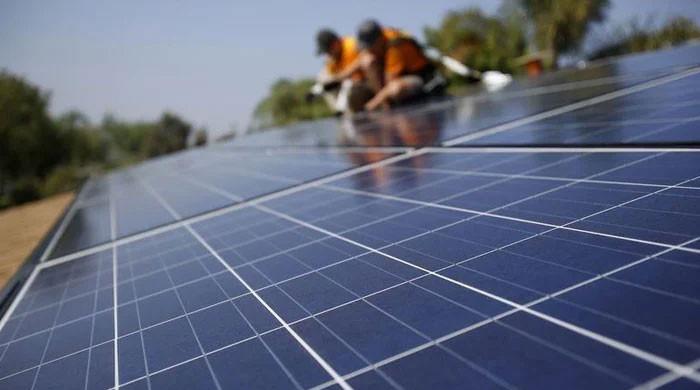
ISLAMABAD:The National Assembly Standing Committee on Finance on Tuesday unanimously rejected the proposed 18% sales tax on the import of solar panels, while the government also announced the withdrawal of another controversial measure to increase sales tax on hybrid vehicles, reversing both the anti-environment initiatives.
The committee in its meeting, chaired by Pakistan Peoples Party’s (PPP) National Assembly member (MNA) and former finance minister Syed Naveed Qamar, also raised questions on the proposed new bill, the Digital Presence Proceeds Act 2025 but did not announce its judgment.
The rejection of the 18% sales tax on import of solar panels and its parts, as announced by Qamar, is the first such rejection by the committee after it started discussing the Finance Bill. Unlike the Senate, the decisions of the National Assembly or its standing committee are binding in case of the Finance Bill.
The government had estimated Rs20 billion in revenues from the 18% sales tax on the import and supply of photovoltaic cells, whether assembled or not. Since the IMF had not endorsed the proposal, the rejection by the committee will not have any adverse implications for the IMF programme.
During the committee meeting, Federal Board of Revenue (FBR) Chairman Rashid Langrial argued that sales tax had already been levied on the local assembly of the solar panels; therefore, the rejection of the import stage tax could put the local industry at a disadvantage.
However, he could not give firm figures about the share of the local industry in the total sales but said that a very few percentage was supplied locally. “If the government did not accept our rejection, the National Assembly will veto it,” Qamar said.
Qamar asked the government to find other ways for incentivising the local industry. Finance Minister Muhammad Aurangzeb said that the era of giving subsidies had ended. On that Qamar reminded him that the government had just announced subsidies in the budget for electric vehicles.
In the budget, the government had imposed 1% to 3% car engine levy to raise Rs10 billion for funding the electric vehicles. “It is a cross subsidy on electric vehicles”, Aurangzeb said. “It is still a subsidy funded by someone else,” retorted Qamar.
The government has long been trying to discourage the use of solar panels – a source of cheaper electricity – over the government-sold expensive grid-based power. “No political party in the National Assembly has supported the 18% tax and the government will have to withdraw it,” Qamar said. The finance minister acknowledged the feedback.