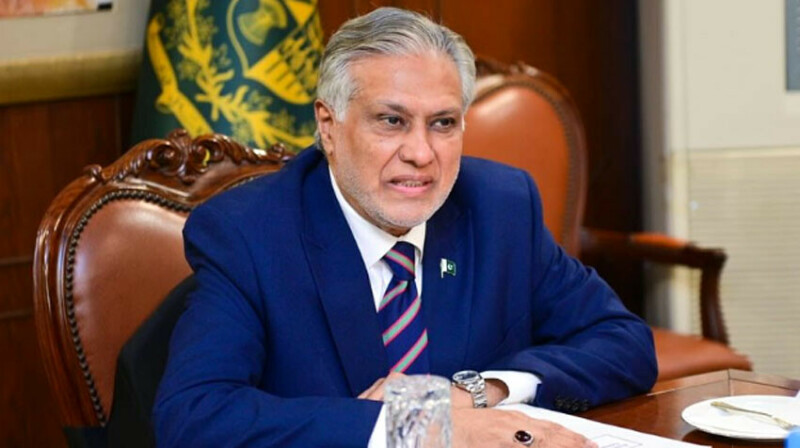
Pakistan’s Deputy Prime Minister Ishaq Dar has stated that ‘if my advice had been followed in 2017, we wouldn’t have had to beg for help for the next five years.’
Addressing overseas Pakistanis in New York, Dar further said that in 2017, Pakistan had become the 24th largest economy in the world, “but after that, the country found itself on the brink of bankruptcy.””Despite all the political challenges, we managed to save Pakistan from going bankrupt,” he added.
He further discussed the improvements in the economy, saying, “Inflation has decreased, the policy rate has been reduced, and there are now signs of economic stability. Before the 2013 elections, Pakistan was seen as an economically unstable country, but after we won, we turned things around and improved economic indicators in just three years.”
Dar pointed out that between 2013 and 2017, inflation was brought down to 3.6%, interest rates dropped to 5%, and load shedding was completely eliminated. “We also invested heavily in fighting terrorism, which brought peace to the country. With operations like Zarb-e-Azb and Radd-ul-Fasad, Karachi’s lights came back on, and for the first time, Pakistan successfully completed the International Monetary Fund (IMF) programme.”
“At that time, global financial institutions were praising Pakistan’s economy, and they even predicted that we would join the G20 by 2030. But after the change of government in 2018, our economy weakened and fell to 47th place, nearing bankruptcy,” he said.
Dar emphasized, “When the Pakistan Democratic Movement (PDM) government took over in 2022, we had to put political interests aside to save the country from bankruptcy. If my advice in 2017 had been taken, we wouldn’t have faced these problems.”
He added, “When I got another chance in 2023, I worked to bring the economy back to stability. Inflation dropped to 6.4%, interest rates fell from 22% to 12%, and our foreign exchange reserves and exports increased. Now, global institutions are once again praising Pakistan’s economic recovery.”
Addressing the terrorism issue, Dar said, “In 2014, we allocated substantial financial resources to combat terrorism, which restored peace. But now, terrorism is resurging, and the lack of policy continuity is to blame. The previous government made deals with terrorist groups, which led to the release of those involved in serious crimes, and this created instability.”