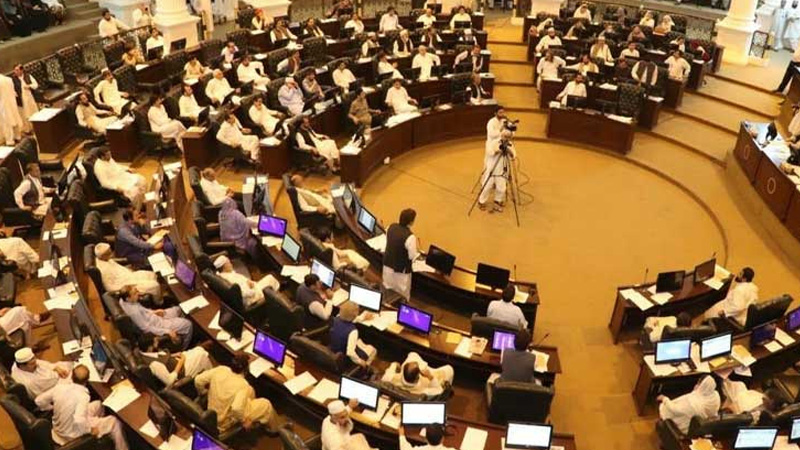
Amid protests from the opposition benches, the Khyber-Pakhtunkhwa (K-P) government presented a Rs2.119 trillion surplus budget for the fiscal year 2025–26 in the provincial assembly, describing it as a historic step towards economic recovery after inheriting what it called a financially crippled province.
The provincial government claimed the budget not only reflects sound fiscal management but also addresses critical development, salary, pension, and debt servicing needs despite significant financial constraints and unpaid dues from the federal government.
The session of the K-P Assembly, presided over by Speaker Babar Saleem, began with the budget presentation by Minister for Law Aftab Alam, who also holds the portfolio for finance.
He stated that when Chief Minister Ali Amin Gandapur took charge, the province’s financial condition was dire due to what he described as the “mismanagement of the unconstitutional caretaker setup.”
He added that the treasury barely held enough funds to cover 15 days’ worth of salaries, major development projects had stalled, the health card scheme had been discontinued, wheat reserves were insufficient to meet provincial needs, and the province was saddled with mounting debts.
The finance minister noted that despite these circumstances, the provincial government not only achieved but surpassed its surplus target, terming it the largest surplus in the province’s history, adding that the government now holds enough reserves to pay salaries for three months.
He further claimed that the budget outperforms the combined surpluses of several previous years.
During the current fiscal year, the government invested Rs150 billion into a provincial development fund — an amount that equals around 20 per cent of the province’s total debt portfolio. It also repaid Rs49 billion in outstanding loans, which included Rs18 billion in interest payments.
The total expenditure for the next fiscal year has been estimated at Rs1.962 trillion, against expected revenues of Rs2.119 trillion, creating a projected surplus of Rs157 billion.
The budget estimates Rs177 billion in foreign assistance through grants. The allocation for current expenditures, including salaries, pensions, and operational costs, stands at Rs1.415 trillion. Of this, Rs1.255 trillion has been earmarked for the settled districts, while Rs160 billion will go to the merged tribal districts.