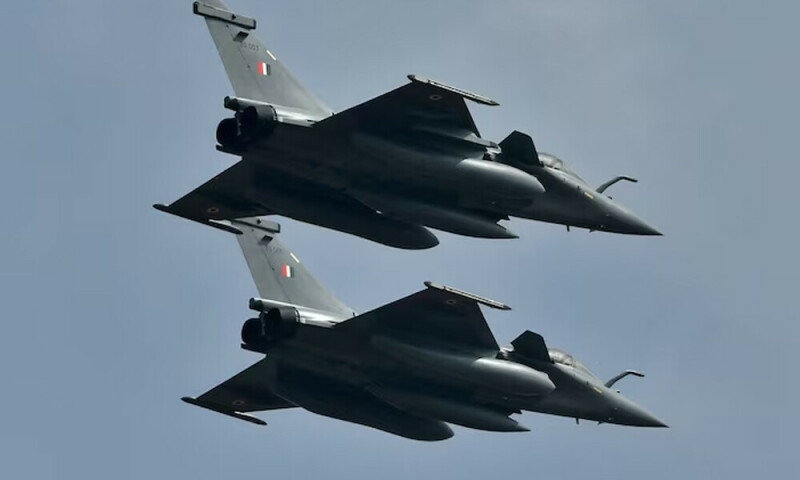
The recent escalation between Pakistan and India, which brought both nuclear-armed neighbours to the brink of full-scale war, marked a significant shift in the nature of warfare between the two countries.
For the first time, French-made 4.5 gen Rafale fighter jets operated by India were downed in combat.
Unlike previous conflicts, Pakistan did not rely on US-supplied weaponry, while India has increasingly shifted from Russian arms to equipment sourced from Western countries.
The development is viewed not just as a Pakistan-India engagement, but as a real-world proxy test of Chinese versus Western military technology—potentially fuelling new competition in the global arms market and drawing diplomatic attention from Paris, Washington, and NATO-aligned states.
Several analysts have highlighted the air force engagements, with some pointing to the possible role of Chinese-supplied PL-15 air-to-air missiles perhaps being the difference-maker.
Images shared on social media show a section of the missile’s fuselage with visible serial markings and a seeker test port. Another image appears to show the missile’s seeker head, equipped with an active electronically scanned array (AESA) radar, known for improved tracking and resistance to jamming.
The PL-15, developed by China’s Aviation Industry Corporation (AVIC), is a long-range, radar-guided missile designed to engage high-value airborne targets at ranges exceeding 200 kilometres.
PL-15 is China’s standard active-radar-guided AAM, and it was intended to at least match the performance of the US-made AIM-120D Advanced Medium-Range Air-to-Air Missile (AMRAAM).
Its export version, the PL-15E, is reported to have a maximum range of 145 kilometres and is integrated with Pakistan’s JF-17 Block III and J-10CE fighters.
The domestic version in use of the Chinese military has a reported range of between 300-500 kilometers.
The Pakistan Air Force (PAF) released visuals on April 26 showing JF-17s armed with PL-15E and PL-10 missiles. Pakistan’s fleet includes an estimated 45–50 JF-17 Block IIIs and 20 J-10CEs—approximately 70 aircraft capable of deploying the PL-15E.
The missile’s guidance system includes inertial navigation, Beidou satellite updates, a two-way datalink, and AESA radar terminal homing.It features a dual-pulse solid rocket motor and can reach speeds exceeding Mach 5. The warhead, typically high-explosive fragmentation, weighs between 20 to 25 kilograms.