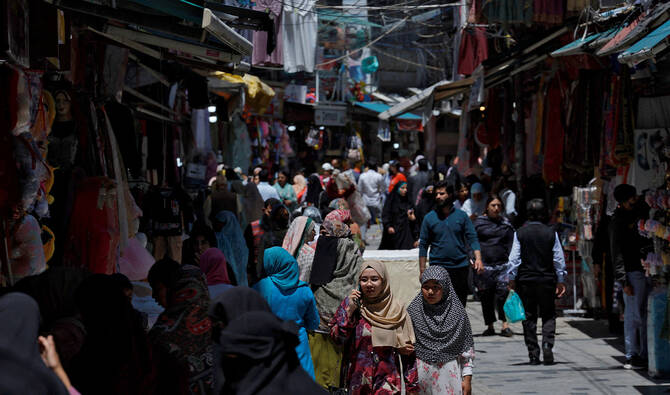
CHAKOTHI: Shops began reopening in Azad Kashmir on Sunday (May 11) after India and Pakistan agreed to a ceasefire along their contested border, but residents expressed doubts about how long the peace would last without a political solution to the decades-old Kashmir dispute.
The border town of Chakothi, which had borne the brunt of recent cross-border shelling, showed tentative signs of normalcy as shopkeepers returned to assess damage and restart businesses. Many residents who had fled the violence remained hesitant to return.
“We’ll restart business but it will take time,” said Shabbir Abbasi, a shopkeeper and head of the local traders’ union. “People won’t come back until there’s a proper ceasefire agreement.”The nuclear-armed neighbors agreed to stop cross-border firing in Kashmir, but locals said temporary truces were not enough.
“The Kashmir issue must be resolved now if they want real peace,” Abbasi told Reuters.Some residents welcomed the pause in violence but remained skeptical. “A ceasefire is good, but talks to resolve Kashmir would be better,” said Mohammad Aslam, a Chakothi resident.
Muhammad Munir noted that people don’t rely much on ceasefire agreements. “Today there is a ceasefire but by evening there may be firing here,” he said. “That’s why people don’t rely on this too much, they don’t think this is a final thing.”
Hafiz Muhammad Shah Bukhari, a resident of district Poonch in India, was also happy at the cessation of hostilities. “There is a lot of joy in the village [after ceasefire],” he said. “Personally, I am very thankful to Allah. It is a very good decision that the shelling has stopped.”
Saturday’s ceasefire marks the temporary end to fighting that started on Wednesday (May 7), two weeks after 26 men were killed in an attack targeting Hindus in Pahalgam in Indian-administered Kashmir.
Meanwhile, Azad Jammu and Kashmir (AJK) educational authorities has announced the reopening of all public and private educational institutions across the state, following a ceasefire agreement between India and Pakistan.
The decision marks the resumption of academic activities in schools, colleges, and universities, which had been temporarily suspended due to recent cross-border tensions.Notifications have also been issued in this regard.
The closures were enforced on May 7 after Indian drone attacks targeted areas in Punjab and Azad Jammu and Kashmir. In response to the security situation, the education department had declared a temporary suspension of classes in all public and private institutions.
Meanwhile, Defence Minister Khawaja Asif said on Monday that any future talks between Pakistan and India would center around three critical issues ‘Kashmir, terrorism, and water disputes’, ARY News reported.