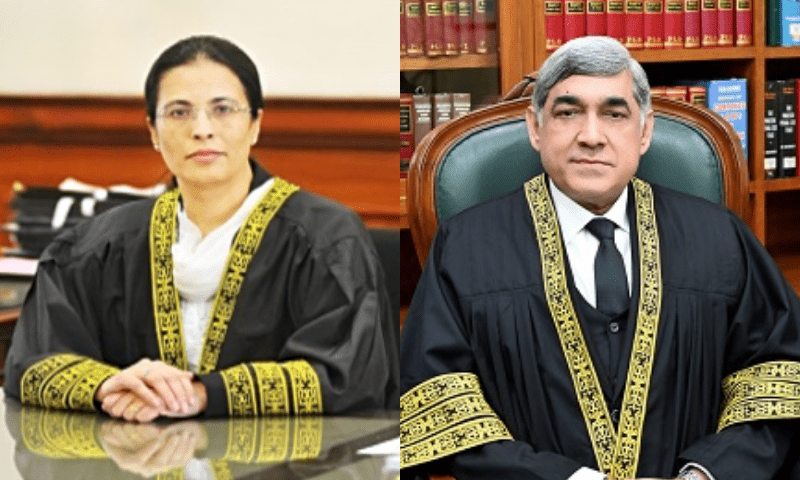
As the constitutional bench (CB) of the Supreme Court on Monday took up a set of review pleas against the top court’s ruling that had declared the PTI eligible for reserved seats, two judges declared the petitions as inadmissible.
In its July 12, 2024 short order, eight out of 13 judges ruled that 39 out of a list of 80 MNAs were and are the returned candidates of the PTI, setting it to emerge as the single largest party in the National Assembly.
However, the ruling had not been implemented by the National Assembly, while the Election Commission of Pakistan (ECP) had raised some objections. The review petitions against the SC order had been filed by the PML-N, the PPP and the ECP.
As the full-strength 13-member CB led by Justice Aminuddin Khan took up the review pleas today, Justices Ayesha A. Malik and Aqeel Ahmed Abbasi objected to them, declaring the applications as inadmissible.
The other 10 members of the bench were Justices Jamal Khan Mandokhail, Muhammad Ali Mazhar, Syed Hasan Azhar Rizvi, Musarrat Hilali, Naeem Akhter Afghan, Shahid Bilal Hassan, Muhammad Hashim Khan Kakar, Salahuddin Panhwar, Aamer Farooq and Ali Baqar Najafi.
Five of the eight judges who ruled in PTI’s favour — namely senior puisne judge Justice Mansoor Ali Shah, Justice Munib Akhtar, Justice Athar Minallah, Justice Shahid Waheed and Justice Irfan Saadat Khan — are not part of the CB.
While Justices Mazhar, Ayesha and Rizvi were part of that majority verdict, Justices Aminuddin and Afghan had rejected the PTI’s pleas, denying it the reserved seats.According to a cause list issued by the SC, the review pleas included three filed by the PML-N, including one by its leader Huma Akhtar Chughtai, as well two each from the PPP and the ECP.
Barrister Haris Azmat appeared as the counsel for the PML-N while Sikandar Bashir Mohmand was present on behalf of the ECP.During the hearing, judges of the apex court repeatedly questioned the ECP lawyer about the electoral watchdog not implementing the July 12 verdict.
While the CB formally accepted the review petitions for hearing, Justices Ayesha and Abbasi dissented with the majority decision, objecting to the maintainability of the pleas.