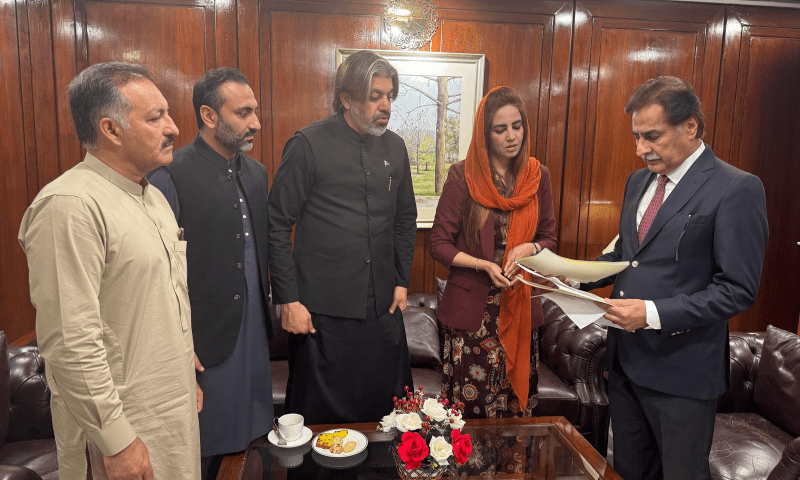
The PTI has submitted a resolution in the National Assembly against the planned construction of six new canals on the Indus River.
Chief of the Army Staff Gen Asim Munir and Punjab Chief Minister Maryam Nawaz inaugurated the ambitious Cholistan project to irrigate south Punjab’s lands on February 15 amid public uproar and strong reservations in Sindh.
The contentious $3.3 billion Green Pakistan Initiative (GPI) launched by the federal government to develop six canals to irrigate 1.2 million acres of “barren land” in south Punjab has been strongly opposed by the PPP, which is in power in Sindh, as well as farmers and other stakeholders.
Today, PTI lawmakers — including its NA parliamentary leader Zartaj Gul, Ali Muhammad Khan and Mohammad Ahmed Chattha — submitted a resolution to Speaker Ayaz Sadiq against the canals project.
The resolution, a copy of which is available with Dawn.com, demanded that the “construction of the Cholistan canal projects” should be suspended immediately until the Council of Common Interest (CCI) approves it.
The PPP has repeatedly called for a meeting of the CCI — empowered to decide, formulate and regulate policies concerning interprovincial and centre-province matters — to be convened.The resolution said the CCI’s approval for the project was needed to “safeguard inter-provincial harmony and compliance with constitutional norms”.
Citing Article 154 of the Constitution (CCI’s functions and rules of procedure), the PTI called on the government to convene an emergency meeting of the council within 15 days to deliberate and resolve Sindh’s reservations concerning the project under the GPI, “ensuring all provincial stakeholders are heard”.
The resolution also demanded an independent audit of the Indus River System Authority’s (Irsa) water availability certificate issued for the Cholistan canals.
It said the audit should be conducted by a “neutral panel of hydrologists and environmental experts within 60 days, with findings tabled before this House to verify compliance with the Water Apportionment Accord 1991, and assess impacts on Sindh’s water share”.
On Monday, the Sindh High Court restrained Irsa and others from taking any further action on the planned construction of the canals, based on the issue of an improper appointment to the authority.