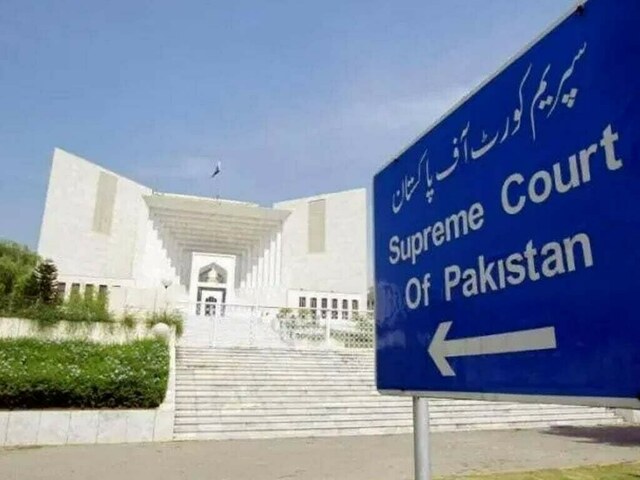
ISLAMABAD: During the Supreme Court hearing on the super tax case, Justice Muhammad Ali Mazhar raised concerns about the indefinite continuation of the tax, which was originally introduced for a specific purpose.
A five-member constitutional bench, headed by Justice Amin-ud-Din Khan, presided over the proceedings, with lawyer Makhdoom Ali Khan representing the companies challenging the levy.
Khan informed the court that the government had initially implemented the super tax in 2015 to generate funds for rehabilitating areas affected by Operation Zarb-e-Azb. However, he argued that despite being introduced as a one-time measure, the tax had remained in effect for several years.
He said that the government imposed the super tax through the 2015 Money Bill as a one-time measure. However, it remained in place from 2015 to 2022.
Initially, the government aimed to collect an estimated Rs 80 billion, but it remains unclear how much revenue was actually generated under this tax. He urged the court to question the government about the total amount collected under the super tax.
Justice Jamal Khan Mandokhail inquired whether any records were available regarding the total revenue collected from the super tax. Khan responded that no finance minister had ever mentioned the recovery or expenditure of the super tax in any speech.
Justice Mandokhail noted that the super tax was meant for the rehabilitation of those affected by the military operation, adding that terrorism remains a daily challenge. He questioned the total number of displaced persons and the specific areas affected by the operation.
Justice Mandokhail further asked about the government’s rehabilitation plan for the affected areas, whether a PC-1 had been prepared for the resettlement of displaced persons, and if any cost estimates had been calculated. He also questioned whether taxes on services could be imposed through a money bill.
In response, Khan argued that the government had already levied income tax on revenue, and to avoid double taxation, it had named it a super tax. He also pointed out that social welfare had been devolved to the provinces, meaning this was not a super tax but simply another tax.