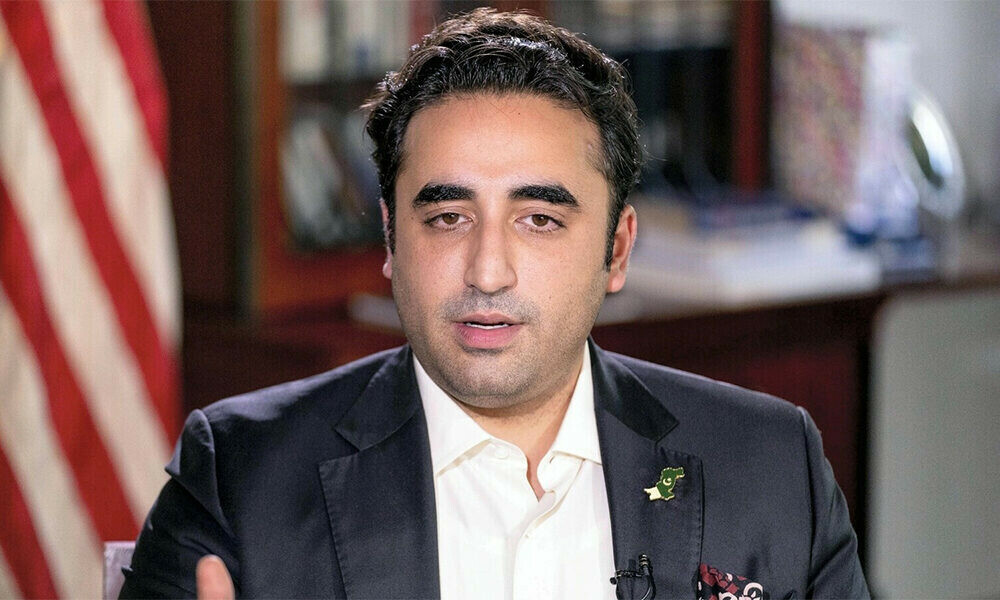
ISLAMABAD:Former foreign minister Bilawal Bhutto Zardari said on Tuesday that “if” the premier spy agencies of both Pakistan and India “sit together” and collaborate with each other there could be a significant decline in terrorist activities in the region.
Bilawal, who is leading a multi-party delegation to world capitals to present Pakistan’s stance on the recent escalation with India, told a press conference in New York that the ceasefire between the two countries was a “welcome first step”, yet it was merely a first step.
Bilawal’s press conference came just before his departure for Washington for the delegation’s meeting with top US leaders and lawmakers. At the UN, he held several meetings with ambassadors from the Security Council (UNSC) members, including the US, France, and the current president of Guyana.
Bilawal suggested instead of accusations, counteraccusations and finger-pointing over terrorism, the effective way would be for Pakistan and India to work together to combat this menace.
“I am completely confident that if ISI [Inter-Service Intelligence of Pakistan] and RAW [Research and Analysis Wing of India] sat down and worked together to fight these forces, we would see a significant decrease in terrorism both within India and Pakistan,” he said.
He pointed out that Pakistan was the biggest victim of terrorism and suffered far more terrorist attacks than India. “If you compare the number of victims to terrorism then far more Pakistanis are killed by terrorists than Indians,” he told the media.
Bilawal condemned India’s illegal strikes inside Pakistan on May 7, calling them a violation of the UN Charter and international law. He said the attacks targeted civilian infrastructure, places of worship, dams, and water and energy facilities, causing civilian casualties, including women and children.
He also rejected India’s “new normal” doctrine as “new abnormal” that it was trying to impose on the region. “We can’t leave the fate of 1.5 or 1.7 billion people in the hands of non-state actors and terrorists, allowing them to decide on a whim that two nuclear-armed powers should go to war.”
He blamed India for using the April 22 Pahalgam attack in Indian Illegally Occupied Jammu and Kashmir (IIOJK) as a pretext for aggression. He said that India rejected Pakistan’s offer for investigation and instead launched strikes against Pakistan.