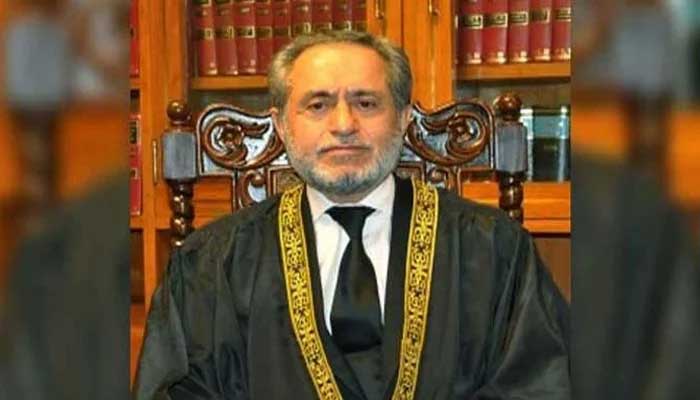
Supreme Court’s Justice Jamal Mandokhailraised question regarding the scope of the Army Act’s jurisdiction, asking whether a member of the armed forces committing an offence at home would be subject to military trial.
The remarks came as a seven-member constitutional bench, led by Justice Aminuddin Khan, heard intra-court appeals against military trials of civilians.Lawyer Salman Akram Raja, counsel for convict ArzamJunaid, presented his arguments before the court.
During the hearing, Raja argued that the case involved two issues, one of which was related to Article 175. He said that the doors would not be closed as far as fundamental rights were concerned.
Justice Mandokhail inquired whether merging fundamental rights with a specific act could lead to their violation. He further questioned if a soldier, marrying a second time without his first wife’s consent, would be tried in a military court.
Raja responded by calling the Army Act a “black hole,” arguing that any amendments could compromise fundamental rights. He maintained that for an offence to fall under the Army Act, the offence must be directly related to military service.
Providing an example, Raja said that while kite-flying is banned in Punjab, a military officer engaging in the act while at home would not be subject to a military trial but rather civilian law.
Justice NaeemAkhtar Afghan, while addressing Raja, said that during his party’s (Pakistan Tehreek-e-Insaf) tenure, there was active legislation on the Army Act. Raja, distancing himself from the legislation, said that he had always remained in the opposition and was not part of the PTI back then.
During the proceedings, Raja also referenced the 1975 FB Ali case, where Section 2(1)(d) of the Army Act was first discussed.
Justice Muhammad Mazhar Ali questioned why the apex court repeatedly reviewed Article 2(1)(d), to which Raja replied that legal frameworks evolve, necessitating judicial review. He added that Article 8(3) does not provide an exception for Article 2(1)(d).
Justice Afghan noted that an ordinance for Article 2(1)(d) was introduced in 1967 and questioned whether its expiration rendered it obsolete. Raja countered by citing the Official Secrets Act, which has been in place since 1923, allowing trials under its provisions before 1967.