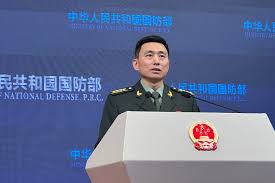
BEIJING (Xinhua/Internews): A Chinese defense ministry spokesperson on Thursday reaffirmed China’s commitment to peaceful development and a defense policy that is defensive in nature while denouncing the U.S. National Defense Authorization Act (NDAA) for the Fiscal Year 2025.
The U.S. NDAA inflated the so-called “China military threat” to justify increased military spending and maintain its global dominance, Zhang Xiaogang, spokesperson for the Ministry of National Defense, said during a regular press conference in Beijing.
He accused the bill of grossly interfering in China’s internal affairs and undermining global peace and stability.The U.S. Senate voted on Dec. 18 to pass the 895 billion-dollar NDAA, which approved military spending. This is a 1 percent increase from last year’s top-line price tag of 886 billion dollars.
“China does not engage in arms races with any country and remains a staunch defender of world peace,” Zhang said in response to a media query about the NDAA, which identifies China as one of the primary challenges to U.S. national security.
Zhang noted that the U.S. military expenditures, already the largest in the world, continue to grow rapidly year after year. This fully exposes the belligerent nature of the United States and its relentless pursuit of hegemony and expansion.
Zhang further highlighted the devastating impact of U.S.-led wars and military operations since 2001, which have caused hundreds of thousands of deaths and millions of injuries and displaced tens of millions of people worldwide.
“We urge the United States to abandon its Cold War mentality and zero-sum mindset and to break free from its delusion of containing and outcompeting China,” he stated.
The spokesperson reiterated that the Chinese military would take firm countermeasures against any infringements or provocations to safeguard the nation’s sovereignty, security, and development interests.
Meanwhile, China once again urges the Philippines to withdraw the U.S. Typhon missile system at an early date, as the deployment of the system brings the risk of geopolitical confrontation and an arms race to the region, a Chinese Foreign Ministry spokesperson said on Thursday.
Spokesperson Mao Ning made the comments at a daily press briefing after Philippine Defense Secretary Gilbert Teodoro attempted to justify U.S. deployment of the Mid-Range Capability missile system in the country. In a statement quoted by the media, Teodoro said that any deployment and procurement of assets related to the Philippines’ security and defense fall within its own sovereign prerogative and are not subject to any foreign veto.
In response, Mao said that China has repeatedly stated its firm opposition on the deployment of the system, adding that the Typhon missile system, with both nuclear and conventional capabilities, is a strategic and offensive weapon, rather than a defensive one.
The Philippines has cooperated with the United States in introducing the system, handing over its own security and national defense to others, bringing the risk of geopolitical confrontation and an arms race to the region, and posing a substantive threat to regional peace and security, Mao noted.
“Whose interests does this move serve, and who is the one to talk about independent diplomacy? This is nothing but a typical ‘harm set, harm get’ situation,” said Mao.